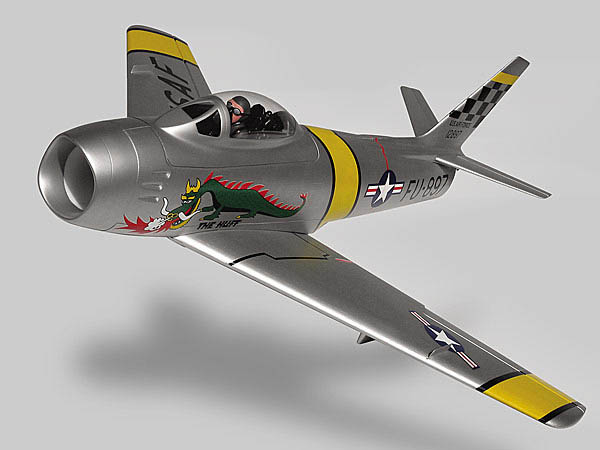
F-86 Sabre
The North American F-86 Sabre — the first U.S. swept-wing fighter and the MiG-killer of the Korean War — captured as an RC EDF scale model.
About
The F-86 Sabre is the United States' first swept-wing fighter and the airframe that took the U.S. into the jet-age air-combat era. The XP-86 prototype was rolled out on August 8, 1947, and made its first flight on October 1, 1947, with George Welch at the controls flying out of Muroc Dry Lake (now Edwards AFB), California. In April 1948, the XP-86 exceeded Mach 1 in a shallow dive, demonstrating the design's high-speed potential.
North American's design team capitalized on captured German aerodynamic data, which had shown that swept wings delayed air-compressibility effects encountered at high subsonic airspeeds and allowed sustained high-speed control. After scale-model wind-tunnel testing, North American adopted a 35-degree swept wing with automatic leading-edge slats to manage low-speed stability — a layout that would influence American fighter design for the next two decades. Production F-86s entered USAF Strategic Air Command service in 1949 and Tactical Air Command service shortly after.
The F-86's defining moment came in the Korean War. Faced with the swept-wing Soviet MiG-15 over the Yalu River, the F-86 became the U.S. counter — flying some of the earliest jet-versus-jet air combat in history. By the end of the Korean War, F-86 Sabres had destroyed almost 800 MiG-15s for the loss of fewer than eighty F-86s, an extraordinary kill ratio that established American jet-fighter dominance for the decade that followed. Production ran from 1949 through 1956 in the United States, Japan, and Italy, with more than 7,800 airframes built across all variants.
The unmistakable F-86 silhouette — clean swept wing, distinctive nose intake, slim fuselage — is one of the most recognizable jet-age fighter shapes in modern RC scale flying. Foam, balsa, and giant-scale F-86 EDF kits are well-represented at scale fly-ins worldwide.
In the simulator
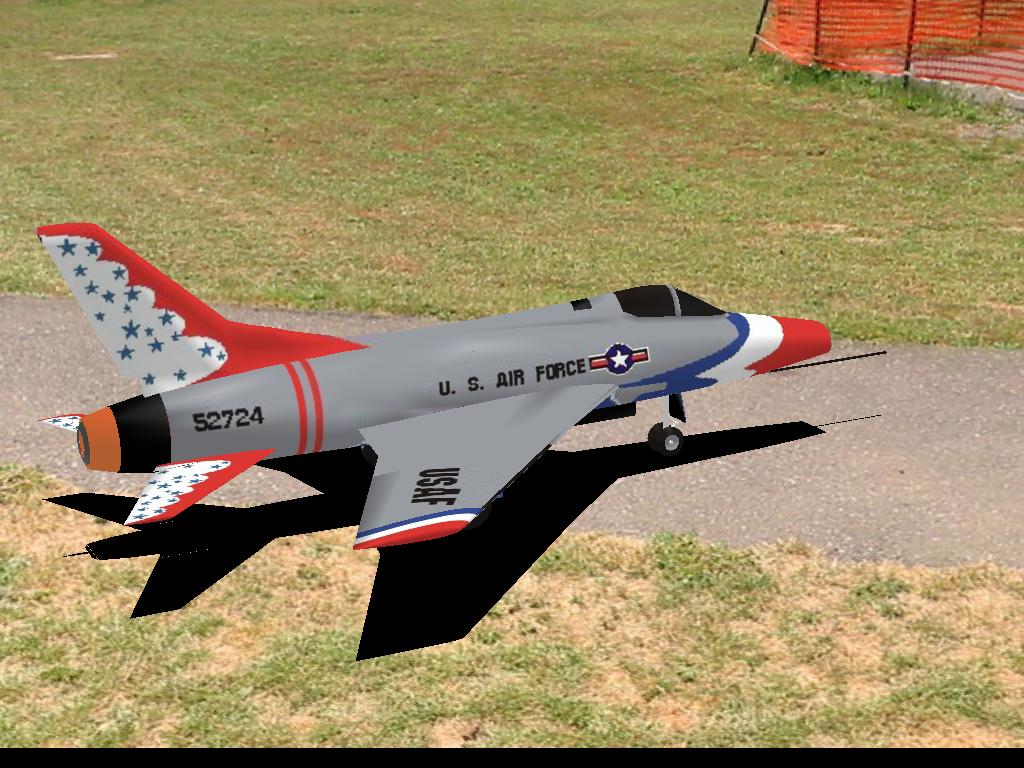
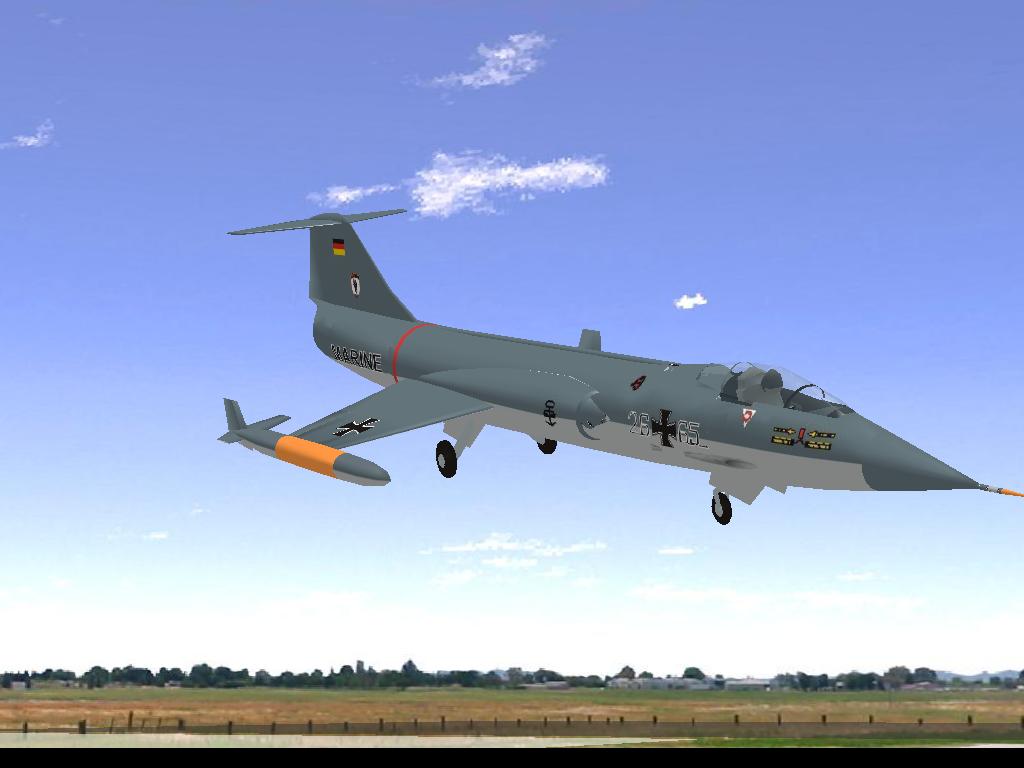
A satisfying introduction to swept-wing jet handling. The F-86 in our sim has the kind of clean aerodynamics and responsive handling that made the real Sabre such an effective fighter. Use it for traditional jet pattern flying — coordinated turns, energy management on approach, the unhurried but precise flying of a 1950s fighter pilot. Pairs well with airport-class landscapes. A natural sibling of the F-100 Super Sabre and F-104 Starfighter in this same pack — three generations of supersonic-era fighter evolution.