Concorde
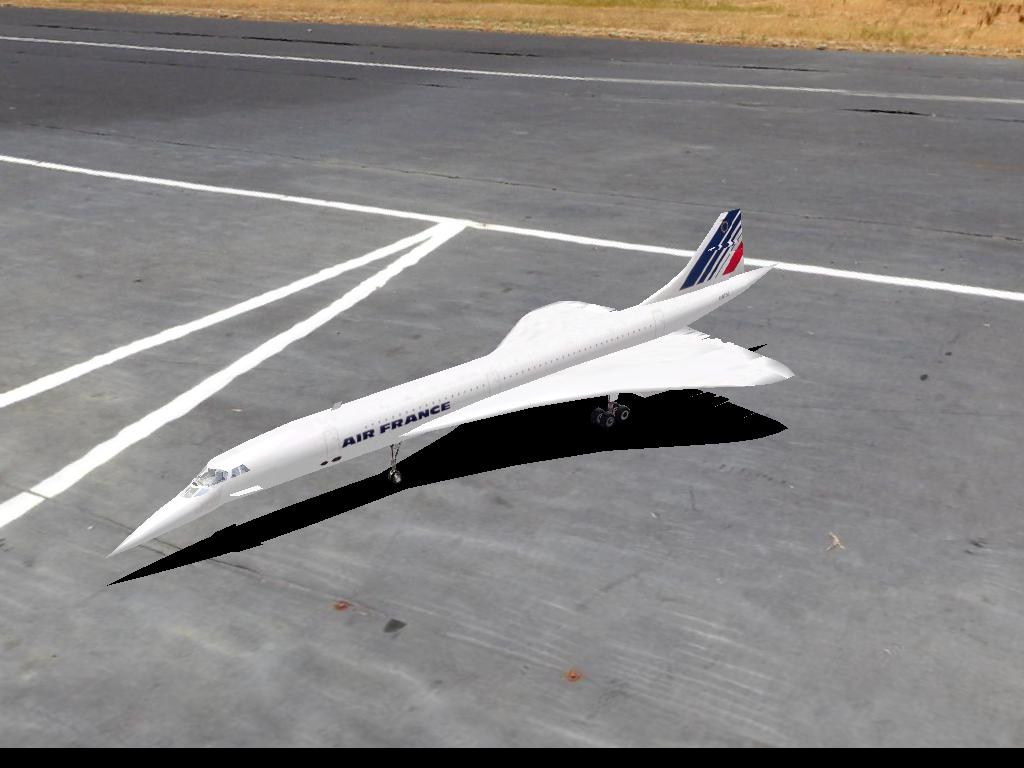
The Concorde — the Anglo-French supersonic airliner that flew passengers from London to New York at twice the speed of sound — captured as an RC EDF scale model.
About
Concorde was the joint product of Sud Aviation (later Aérospatiale) of France and the British Aircraft Corporation (BAC), developed under a 1962 UK-France treaty after engineering studies began in 1954. Construction of six prototypes began in February 1965, and the first prototype made its first flight from Toulouse on March 2, 1969, with André Turcat at the controls. The first British-built Concorde flew from Filton to RAF Fairford on April 9, 1969, with Brian Trubshaw as captain. The type went supersonic for the first time on October 1, 1969, and entered commercial service with Air France and British Airways simultaneously on January 21, 1976.
Concorde was the only commercially successful supersonic airliner ever produced — a Mach-2.04 cruise speed (about 2,179 km/h, more than twice the speed of sound) carried a hundred passengers from London Heathrow or Paris Charles de Gaulle to New York JFK in around three and a half hours, less than half the subsonic flight time. The type's signature features — the long, slender ogival delta wing, the four Olympus turbojet engines (developed jointly by Rolls-Royce and Snecma), and the famous drooping nose that lowered for takeoff and landing visibility — became visual shorthand for "the future of air travel" through the late twentieth century. Concorde service ended in 2003 after twenty-seven years; only twenty airframes were built, and surviving aircraft are preserved at museums around the world.
The unmistakable Concorde silhouette — long, slender, delta-winged, with the signature drooping nose — is one of the most ambitious civilian-jet subjects in RC scale modeling. Foam and composite EDF Concorde models are typically seen at the larger end of the scale-jet category, where the long wingspan and the four engine nacelles make it a serious build.
In the simulator
The most demanding civilian jet in this pack. Concorde's narrow delta wing means high approach speeds, deliberate pattern flying, and the kind of energy management a heavy-jet pilot trains for. Use it to practice large-aircraft jet flying with unique aerodynamic cues — the delta wing produces lift differently from the conventional swept wing of most jet RC models. Pairs with airport-class landscapes that have proper long runways. A unique offering in any pack.