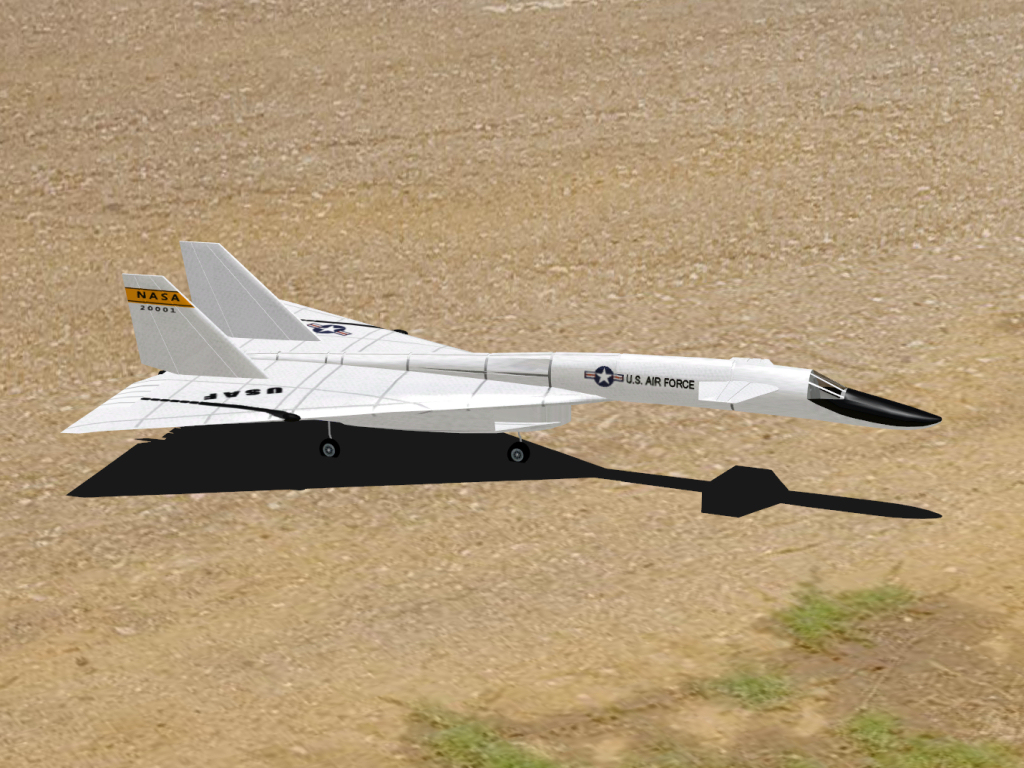
XB-70
The North American XB-70 Valkyrie — the experimental Mach-3 strategic bomber prototype, the largest aircraft ever to fly faster than three times the speed of sound — captured as an RC EDF scale model.
About
The North American XB-70 Valkyrie is one of the most extraordinary aircraft programs of the Cold War. Conceived in the late 1950s as a Mach-3 nuclear-armed strategic bomber to replace the B-52 Stratofortress, the XB-70 was designed to fly at altitudes above 70,000 feet at three times the speed of sound — performance that contemporary Soviet air defenses could not engage. Two prototypes were built, and the first XB-70A made its first flight on September 21, 1964, with North American test pilot Alvin "Al" White and Air Force Colonel Joseph Cotton at the controls.
The XB-70's defining engineering choice was "compression lift" — the foldable wingtips angled downward at high speed used the shock wave from the nose to generate additional lift, dramatically improving cruise efficiency. Six General Electric YJ93 turbojets, the canard nose, and the delta wing produced an aircraft of extraordinary performance — XB-70 #1 reached Mach 3.08 in October 1965.
The program was overtaken by the rise of intercontinental ballistic missiles (which made manned strategic bombing increasingly hard to justify) and by the loss of XB-70 #2 in a midair collision with an F-104 Starfighter on June 8, 1966 — a catastrophic photo-shoot accident that killed test pilots Joe Walker and Carl Cross. XB-70 #1 continued in research flight testing until 1969 and survives today on display at the National Museum of the US Air Force in Dayton, Ohio.
The unmistakable XB-70 silhouette — long needle nose, foldable canards, delta wing with downward-folding tips, six engines on a slab fuselage — is one of the most distinctive aircraft shapes ever produced.
In the simulator
The most ambitious EDF scale subject in this pack. Six engines, substantial inertia, and the kind of approach speeds appropriate for one of the most extreme aircraft of the Cold War. Use it for serious large-aircraft jet pattern flying.