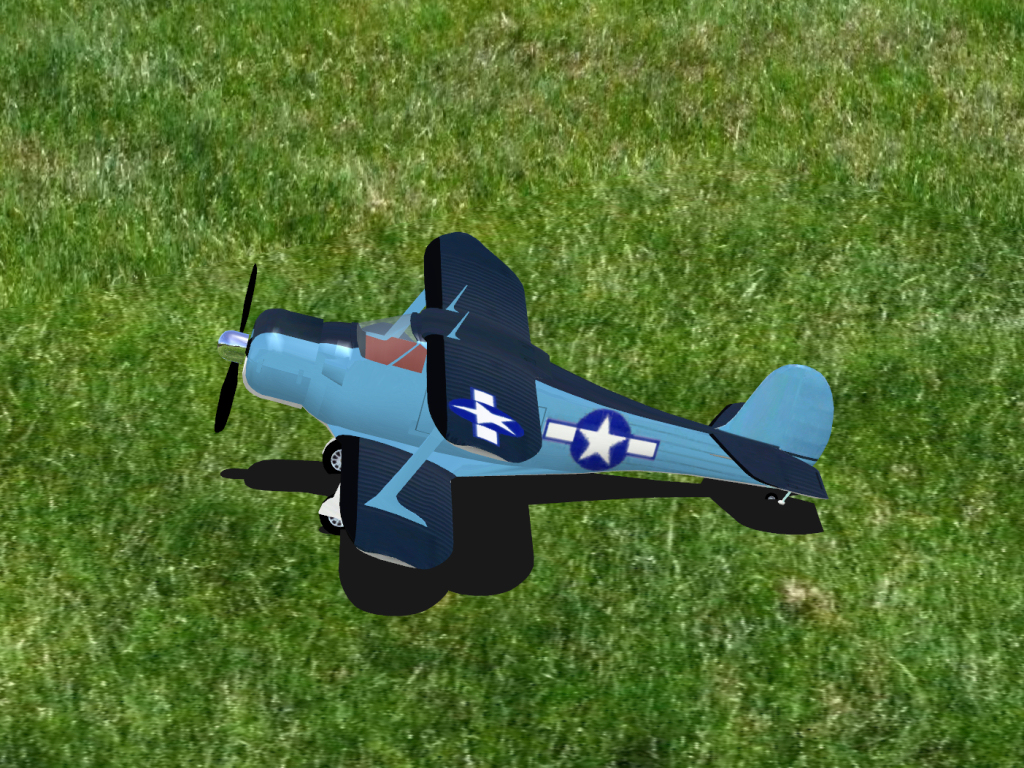
Beechcraft Staggerwing 480
The legendary 1932 negative-stagger biplane that built the Beechcraft name — a golden-age executive aircraft rendered as a graceful 480-size electric RC scale model.
About
The Beechcraft Model 17, almost universally called the "Staggerwing," was Walter H. Beech's first design after leaving Curtiss-Wright to found Beech Aircraft Corporation in Wichita, Kansas in 1932. Based on engineering work by Ted Wells (who had pitched the idea to Curtiss-Wright and been turned down), it took flight on November 4, 1932 — and immediately stood out for its unusual negative wing stagger, with the upper wing set further back than the lower. The arrangement maximised pilot visibility and was thought to reduce interference drag between the two wings.
The Staggerwing was conceived as a luxury executive aircraft at a time when most biplanes were open-cockpit utility machines. Its enclosed four-seat cabin, retractable landing gear, and 200+ mph cruise speed made it one of the fastest civil aircraft of its era — faster, in fact, than many of the military fighters of the day, which made it a popular mount for civilian air-racing pilots like Louise Thaden, who took the 1936 Bendix Trophy in a Staggerwing and beat an entire field of "real" racers in the process. The definitive D17S variant carried a 450 hp Pratt & Whitney R-985 radial; earlier prototypes flew behind a 420 hp Wright R-975. Production ran from 1933 through 1949, with 785 airframes built across civilian, racing, and military variants. During World War II, the Staggerwing served Allied forces as the UC-43 Traveler liaison aircraft. Today, surviving Staggerwings are prized warbirds and routinely command six-figure restoration prices.
The Staggerwing is also one of the most-modeled scale subjects in RC flying. Its unmistakable negative-stagger silhouette appears in everything from electric foam ARF kits to giant-scale gas-powered competition models, and most modern "golden-age scale biplane" RC kits — including the small electric foamies you'll see online — take their proportions directly from the real Model 17. The "480" in the model name refers to the recommended 480-class brushless motor sizing for this RC scale version, a typical electric-flight category for sport-scale models in the 50–60 inch wingspan range.
In the simulator
A satisfying intermediate-level scale subject. The Staggerwing is heavier and more deliberate than a foamy trainer — it wants energy management, smooth coordinated turns, and respect on landing. Taildragger ground handling is realistic (watch the rudder on takeoff). Capable of basic loops and rolls but not designed for hard 3D — fly it as a cross-country sport-scale aircraft and it shines. Pairs beautifully with the rural and grass-strip landscapes (Paradise Landing, Cabo HD). A natural progression from the Magister or Cessna 182 in this same pack.