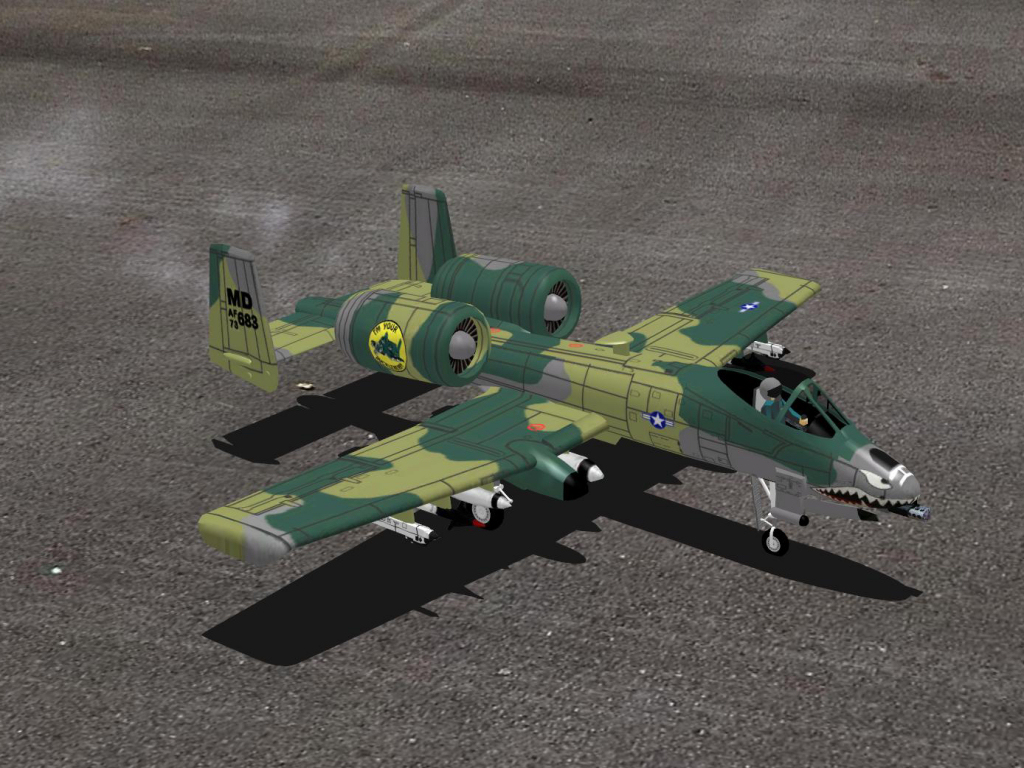
A10 Warthog
The Fairchild Republic A-10 Thunderbolt II "Warthog" — the only US production aircraft designed solely for close air support — captured as a twin-EDF RC scale model.
About
The A-10 Thunderbolt II made its first flight on May 10, 1972, from Edwards Air Force Base, with chief test pilot Howard W. "Sam" Nelson at the controls of the Fairchild Republic YA-10 prototype. The design responded to a 1966 USAF requirement (the A-X Program) for an aircraft purpose-built around the close air support (CAS) mission. Fairchild Republic's design beat Northrop's YA-9 for the production contract, entered service in 1977, and became the only production-built aircraft designed solely for CAS to have served with the U.S. Air Force.
The A-10's design choices reflect its mission. Two General Electric TF34 turbofans mounted high and rearward flank the twin tail — protecting them from ground fire and enabling austere-airfield operations. The signature weapon is the GAU-8/A 30mm rotary cannon, around which the airframe was designed. Versatile underwing hardpoints carry rockets, missiles, and bombs.
The A-10 silhouette is one of the most-modeled jet subjects in modern RC EDF flying. The proportions of countless modern foam and composite A-10 RC kits trace directly back to the real Warthog.
In the simulator
A demanding multi-engine jet that rewards precise throttle management. Substantial inertia, twin-engine asymmetric thrust on landing, and the kind of approach speeds Century Series pilots had to learn. A sibling of the A-10_GWS (CV Planes Pack 1).